
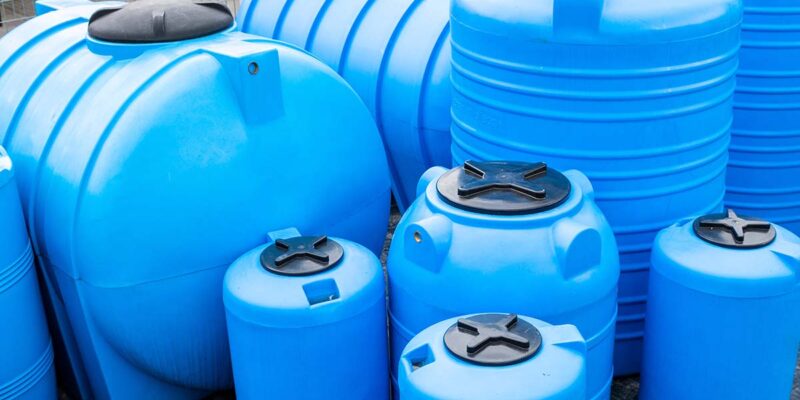
Plastic water tanks play a vital role in society, serving residential, industrial, agricultural, medical, transportation, and even aerospace applications.
At Roto Dynamics, we design and manufacture durable custom plastic water tanks using advanced rotational molding (rotomolding) techniques.
Every rotomolded water tank is designed and manufactured to ensure consistent wall thickness and for strength and long term performance, whether you need 50 custom made plastic water tanks prototypes or a 10,000.
This guide covers the various types of materials we use, the rotational molding manufacturing process, the end-to-end services we provide, and how we solve the most common issues found in the plastic water tank industry. If you are experiencing challenges with your roto moulded water tank manufacturer this article may help you.
Table of Contents
Custom Plastic Water Tank Applications
Roto Dynamics Inc. supplies custom rotomolded water tanks to clients with a wide range of requirements. Some projects require molded in inserts, removable threaded lids, in molded graphics and spinwelded threads. Our customers include OEMs and small to mid size manufacturers who depend on consistent, repeatable quality. Some applications for our rotmolded water tanks include:
- Residential and commercial water storage systems
- Agricultural irrigation tanks and hoppers
- Chemical processing and wastewater management
- Construction and industrial equipment tanks
- Medical, pharmaceutical, and laboratory systems
- Transportation, marine, and RV fresh water tanks
- Aerospace and defense fluid management systems
Whatever your application may be, Roto Dynamics can provide design and manufacturing support to meet your custom water tank critical to function requirements.
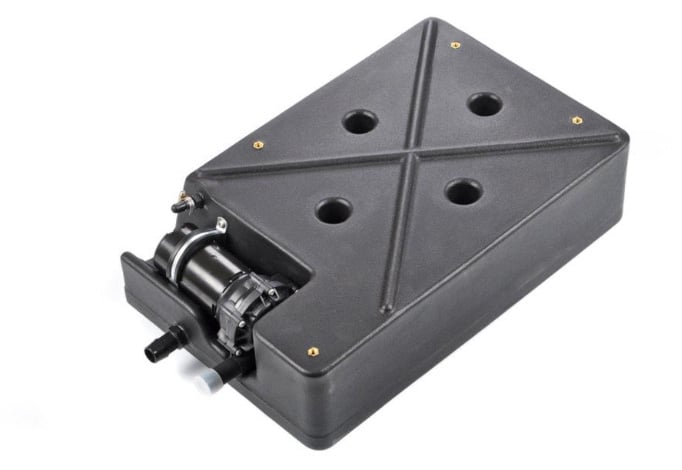

Plastic Resin Options for Custom Rotomolded Water Tanks
Choosing the right material is critical for tank performance, chemical resistance, food-safety compliance, and environmental durability. As an experienced plastic tank manufacturer, we produce custom plastic water tanks using a wide range of resins tailored to the needs of each application. For more detail on our resin options, visit our resin options page.
1. FDA-Compliant LLDPE (Linear Low-Density Polyethylene)
- Most common resin for custom plastic water tanks
- Excellent low temperature impact resistance
- UV resistance for prolonged sunlight exposure
- Safe for potable water and food-contact applications (when specified)
- Cost-effective and durable for large and small tanks
2. FDA HDPE (High-Density Polyethylene)
- Higher stiffness and strength than LLDPE
- Suitable for larger tank designs
- Excellent for rectangular or thin-wall rotomolded water tank designs
3. Polypropylene (PP)
- High heat resistance for elevated temperature environments
- Superior chemical resistance
- Used for tanks exposed to higher service temperatures and certain chemicals.
4. XLPE (Cross-Linked Polyethylene)
- Excellent impact resistance, chemically resistance, and heat resistance
- Ideal for industrial tanks and high-stress environments
- Superior crack resistance and structural integrity
- Commonly selected for heavy-duty custom rotomold tanks with long service life requirements
5. PVDF (Polyvinylidene Fluoride) for Aerospace & High-Performance Needs
- Used for aircraft, defense, and ultra-corrosive environments
- Excellent flame resistance and low flammability
- Exceptional chemical and thermal stability
- When weight, performance, and reliability matter, PVDF is unmatched for critical custom made plastic water tanks
Our design team collaborates closely with plastic resin experts to recommend the optimal plastic resin for your rotational molding water tank project. Our goal is to balance cost, performance and regulatory requirements to ensure long term results.
Our Rotational Molding Manufacturing Process for Plastic Water Tanks
We produce custom rotomolded water tanks using the rotational molding process. This is an ideal process for manufacturing large, seamless, stress-free hollow parts. Rotomolding allows us to manufacture a wide range of roto mould water tank designs, from simple cylindrical cone bottom tanks to interlocking modular tanks with multiple sub assembly components.
How Rotational Molding Works
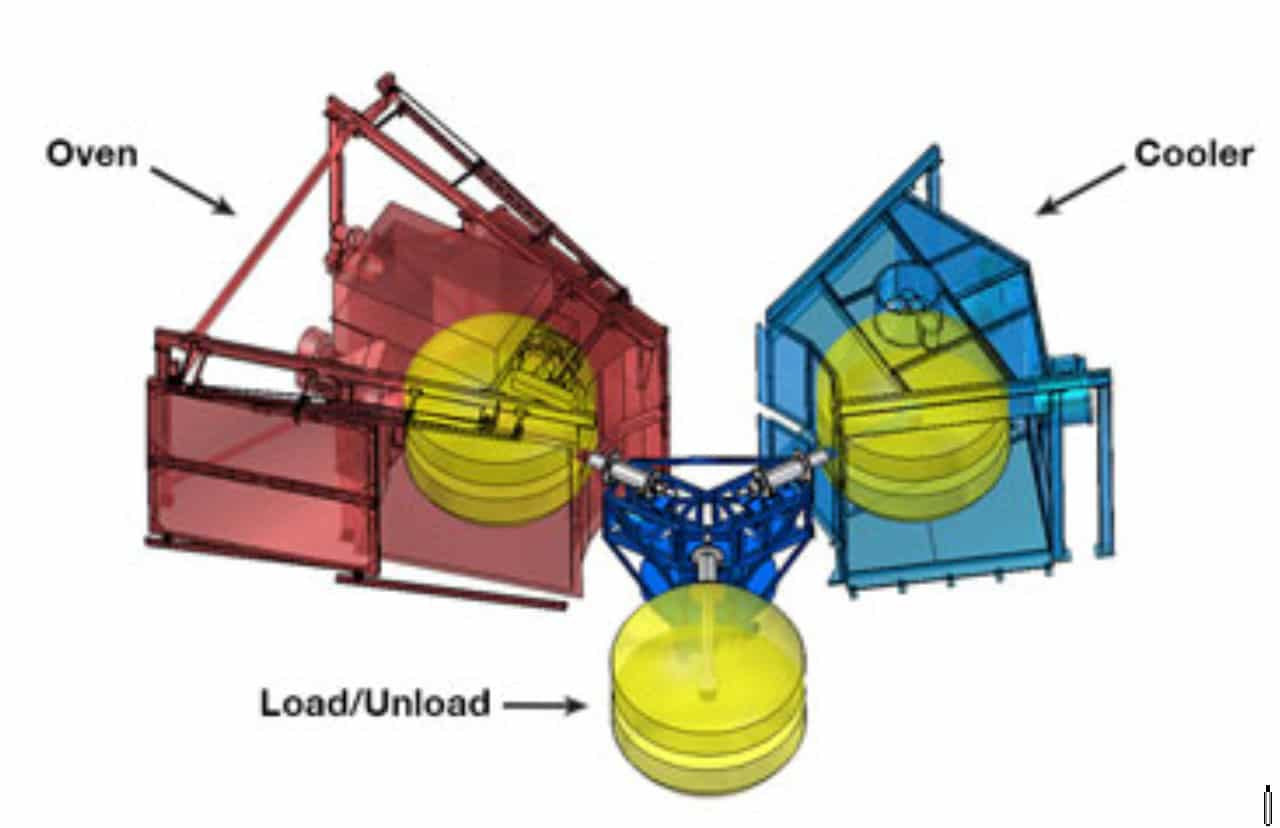
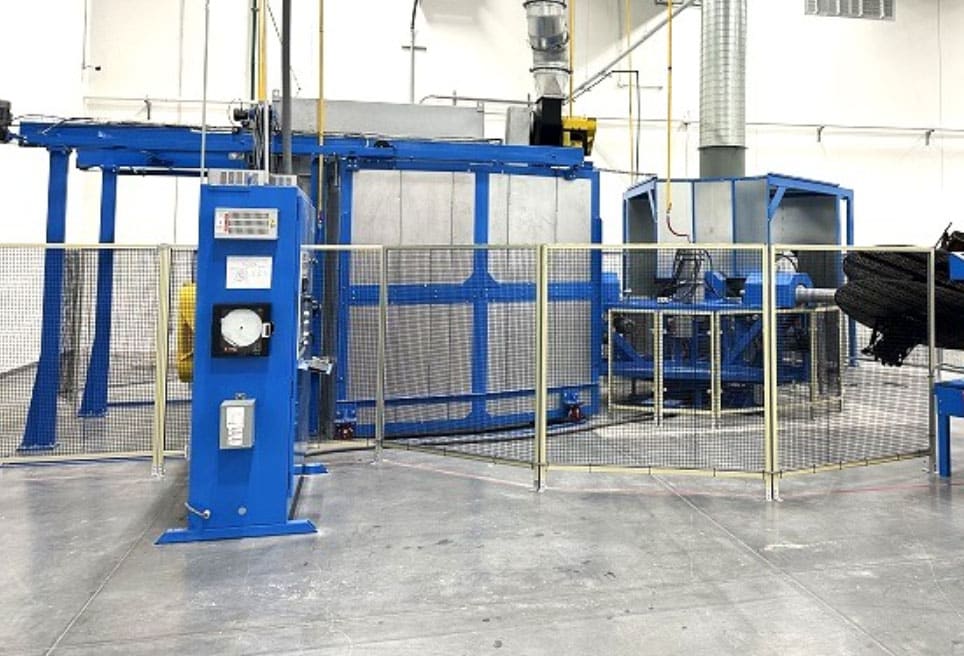
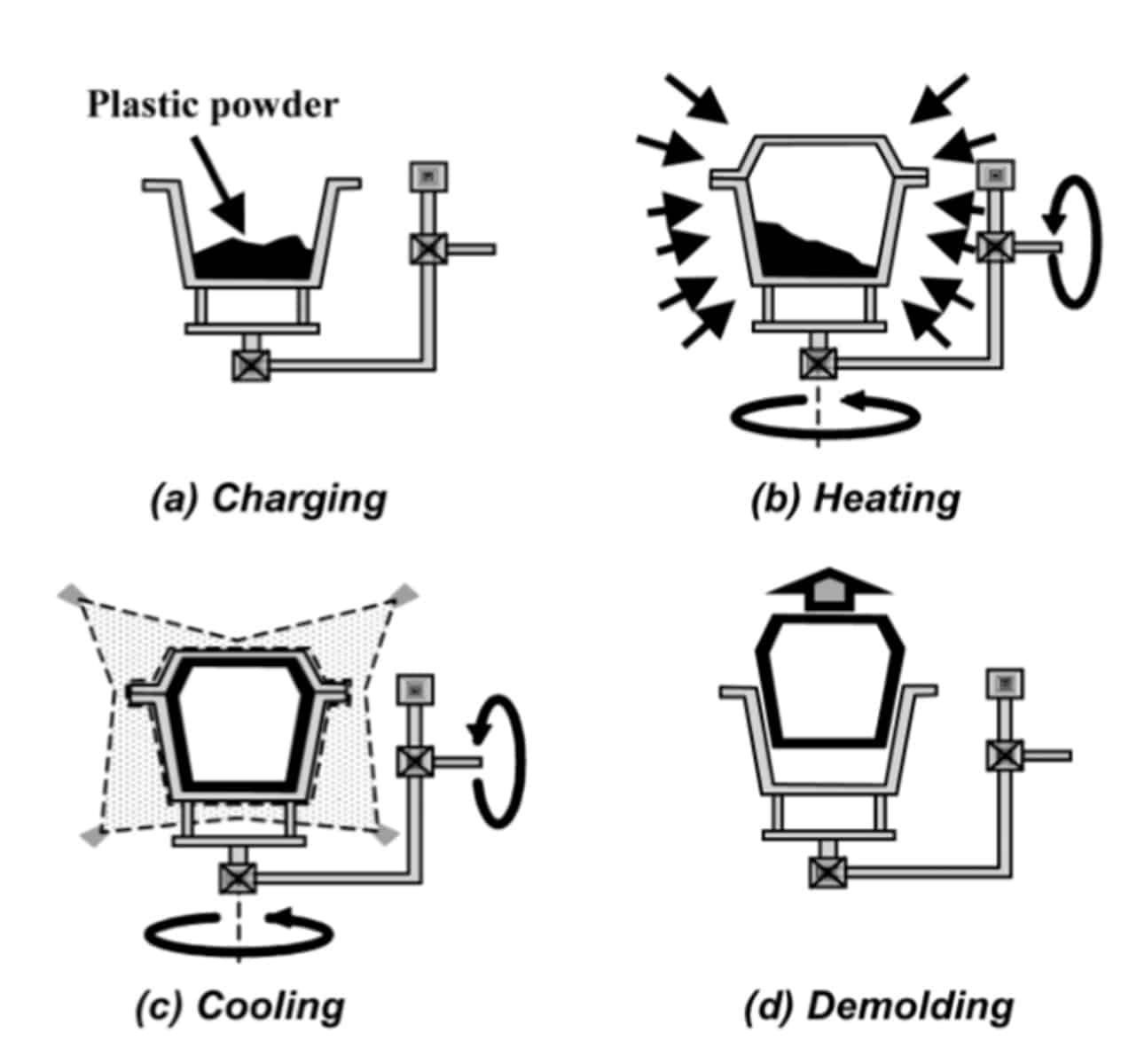
1. Load Plastic Resin Into the Mold
Load/ Unload Bay – Powdered plastic resin is placed inside an aluminum or steel mold. Our mold making partners carefully design and build 3 types of tooling to meet your project requirements (fabricated, cast and CNC machined).

2. Heating & Rotation
Oven – The mold rotates on two axes inside an oven, melting the resin so it coats the interior surface of the mold evenly forming a seamless tank. This biaxial rotation creates a wall thickness that is consistent. This is how custom plastic water tanks are formed.

3. Cooling & Solidification
The mold moves into the cooling chamber where the mold is gradually cooled with mist and air. Controlled cooling helps minimize warping and internal stress, especially in larger rotomolded water tank designs.

4. Demolding & Finishing
Load/ Unload Bay – The tank is removed from the mold and later trimmed and processed through secondary operations such as machining, fitting installation, leak-testing, and assembly. Explore our surface finishing and graphics options as some of these can also be incorporated into plastic tank designs.

Advantages of using the Rotational Molding process for Custom Water Tanks
- No weld lines or seams in the main tank body
- Consistent wall thickness across the tank
- High durability and impact resistance
- Undercuts and handles can be incorporated into a design
- Cost-effective tooling for both low and high volumes
- Excellent choice for custom made plastic water tanks
To learn more about how rotomolding works in detail, visit our rotational molding process page.
Full-Service Manufacturing: From Design to Delivery
Roto Dynamics supports customers at every stage of the product life cycle. If you are looking to manufacture a rotomolded water tank—we provide design feedback, tooling, production, and logistics support. Explore our full list of services on our services page.
Design for Manufacturing (DFM)
Our product development and design team will review your designs to ensure:
- Rotational molding feasibility
- Tooling feasibility
- Critical to function requirements (CTF’s)
- Critical to quality requirements (CTQ’s)
- Parting line locations and draft angles
- Optimal placement of fittings, inserts, and vents.
When needed, we also provide prototyping services to validate form, fit, and function before committing to full-scale production.
Tooling Design & Machining
At Roto Dynamics we provide our customers with confidence that their tooling is being manufactured with efficiency, accuracy and scheduling control. While we specialize in the design and production of rotomolded products, we also collaborate closely with a select group of toolmakers to provide industry leading tooling solutions:
- Cast aluminum molds
- CNC machined molds and fixtures
- Fabricated aluminum molds and fixtures
Learn more about tooling on our mold making, CNC machined tooling, and
fabricated tooling pages.
First Article Inspection (FAI)
Before production release, we:
- Inspect critical dimensions
- Perform leak and pressure tests as required
- Confirm functional, cosmetic, and aesthetic requirements
- Provide detailed First Article Inspection reports
Our quality control program is designed to ensure consistent, repeatable performance for every custom plastic water tank.
Production & Assembly
Once approved, we move into full-scale rotational molding production. Our capabilities include:
- High- and low-volume rotational molding production for custom rotomolded water tanks
- Machining of openings, and precision interfaces
- Foam filling for structural reinforcement and insulation – see our foam filling services
- Product assembly and integration – described on our product assembly
and assembly pages - Hardware, insert, and fitting installation
- Packaging and assembly of multi-component tank systems
Logistics, Warehousing & Fulfillment
We offer flexible logistics solutions tailored to your supply chain. Our logistics and warehousing services include:
- Domestic truck load and less than truck load (LTL) services.
- Kanban stocking and vendor managed inventory (VMI)
- Just-in-time (JIT) delivery programs
- Custom packaging solutions for finished tank systems
Common Water Tank Issues & How We Resolve Them
Even well-designed tanks can experience manufacturing challenges if not produced correctly. Below are common issues seen in plastic water tank manufacturing—and how Roto Dynamics prevents and solves them using robust rotational molding and quality-control practices. If you are facing challenges with your current supplier, Roto Dynamics would be happy to provide input at no charge.
1. Holes on the Parting Line
Common Causes:
- Poor venting of the mold
- Dirty or worn flanges
- Inadequate mold clamping
- Improperly pulverized resin
How We Solve It:
- Proper vent placement and sizing
- Documented flange cleaning and inspection processes or rematch parting lines
- Corrected mold alignment and optimized clamping strategy
- Incoming inspection of plastic resins
Our quality assurance processes ensure clean parting lines with zero porosity, even for complex rotomolded water tank designs.
2. Inserts Bulging or Protruding Through the Tank Surface
Common Causes:
- Inserts not spring loaded or improperly fastened
- Tank wall shrinking away during cooling
- Insert movement during molding
- Incorrect insert design or plastic shrink expectations
How We Solve It:
- Use of spring loaded insert retainers to keep inserts flush
- Optimized cooling cycles to reduce shrink stress
Our insert design and installation process guarantees flat, secure inserts in your custom rotomolded tanks.
3. Warping, Distortion, and Dimensional Deviation
Common Causes:
- Wall thickness variation
- Inadequate venting of the mold
- Improper cooling methods
- Undercured plastic
How We Solve It:
- Check rotation ratios, minimize hotspots
- Ensure vent is of a sufficient diameter and is not blocked
- Controlled and slow cooling
- Oven cycle must be sufficient
4. Leaks Around Fittings or Threads
Common Causes:
- Insufficient material flow around inserts
- Lack of heat transfer through insert resulting in thin spots
- Design feature which restricts the flow of resin
Our Fix:
- Use a resin with a higher melt flow index
- Ensure sufficient heat is being applied to the area in question
- Ensure there is sufficient clearance for resin to flow around the feature
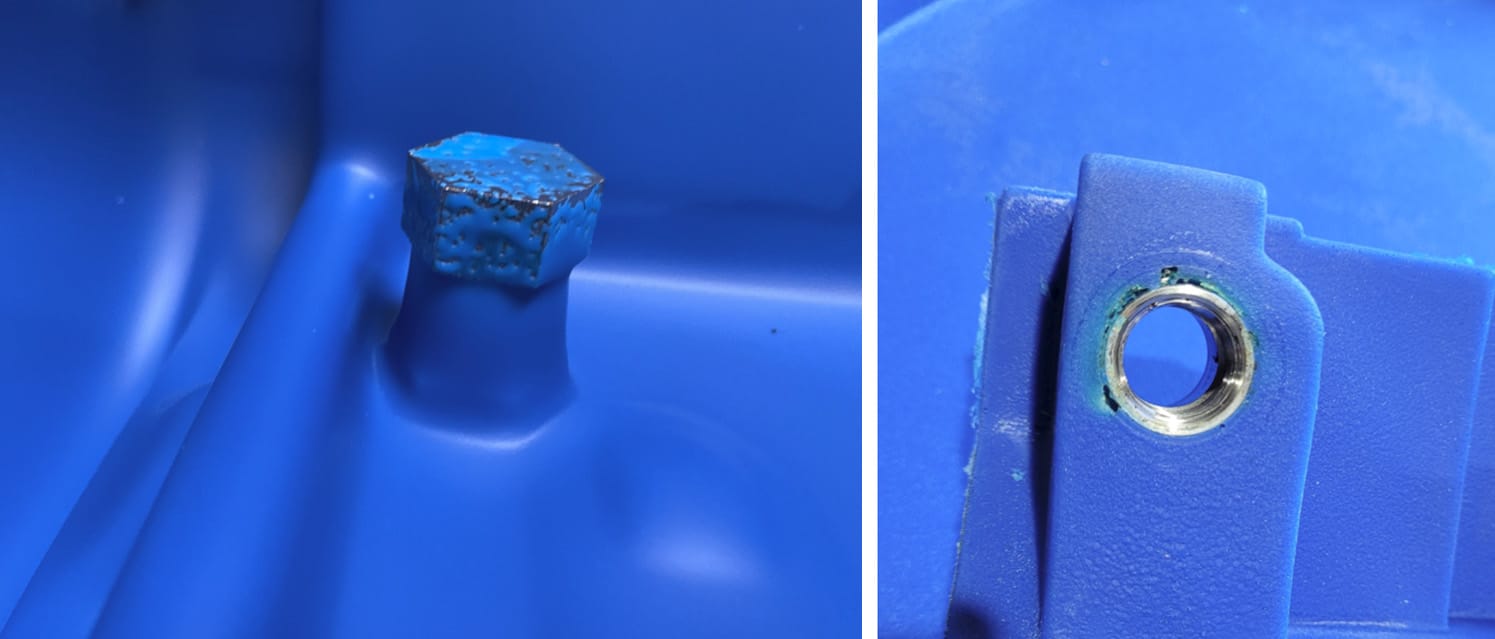
5. Surface Roughness, Pinholes, or Voids
Common Causes:
- Moisture in resin or inadequate resin storage conditions
- Incorrect oven cycle or temperature profile
- Resin contamination or foreign particulates
- Porosity in mold casting
Our Solutions:
- Store resin in a dry environment and seal all packaging
- Ensure part is fully cured
- Carry out incoming inspection procedures when receiving resin

Your Partner for High-Quality Custom Plastic Water Tanks
If you need custom, durable, FDA-compliant, industrial, or aerospace-grade custom plastic water tanks, our design and manufacturing teams are ready to help. From concept to production, we work with you to engineer a rotomolded water tank that meets your exact requirements for performance and cost. To start a new custom water tank project or to transfer an existing tank project to a new plastic tank manufacturer, you can submit your CAD files and specifications through our
request a quote page.
Contact Roto Dynamics
Sales@rotodynamics.com
www.rotodynamics.com
714-685-0183
Frequently Asked Questions About Custom Plastic Water Tanks
What is a rotomolded water tank?
A rotomolded water tank is a hollow plastic tank manufactured using the rotational molding process. Powdered resin is loaded into a mold,
heated while being rotated on two axes, and cooled to create a seamless, stress free tank body. This process is ideal for custom plastic water tanks with simple and complex geometry.
What materials are best for custom plastic water tanks?
The most common materials are LLDPE and HDPE, which offer excellent impact resistance as well as good UV stability. For higher temperatures or possibly aggressive chemicals, PP, XLPE, or PVDF may be recommended. The best resin for your custom plastic water tank depends on the specific application and environment.
Can you design a custom made plastic water tank to fit my equipment?
Yes. Our design team offers complete DFM support and product development services. We can design a custom rotomolded water tank that integrates with your equipment, including mounting features, bulk head fittings, threaded inserts, and fittings.
What is the typical lead time for a new custom rotomold tank?
Lead time depends on tooling complexity and scope of the project. Tooling design and fabrication usually take 8-9 weeks. Once tooling is complete, we can manufacture a custom rotomolded tank within days, and we offer flexible scheduling, warehousing,
and logistics to support ongoing demand.
Do you provide leak testing and quality documentation?
Yes. We provide leak testing, dimensional inspection reports, and First Article Inspection (FAI) documentation as required. Our quality control processes are designed to ensure every rotomolded water tank performs to the highest standard.